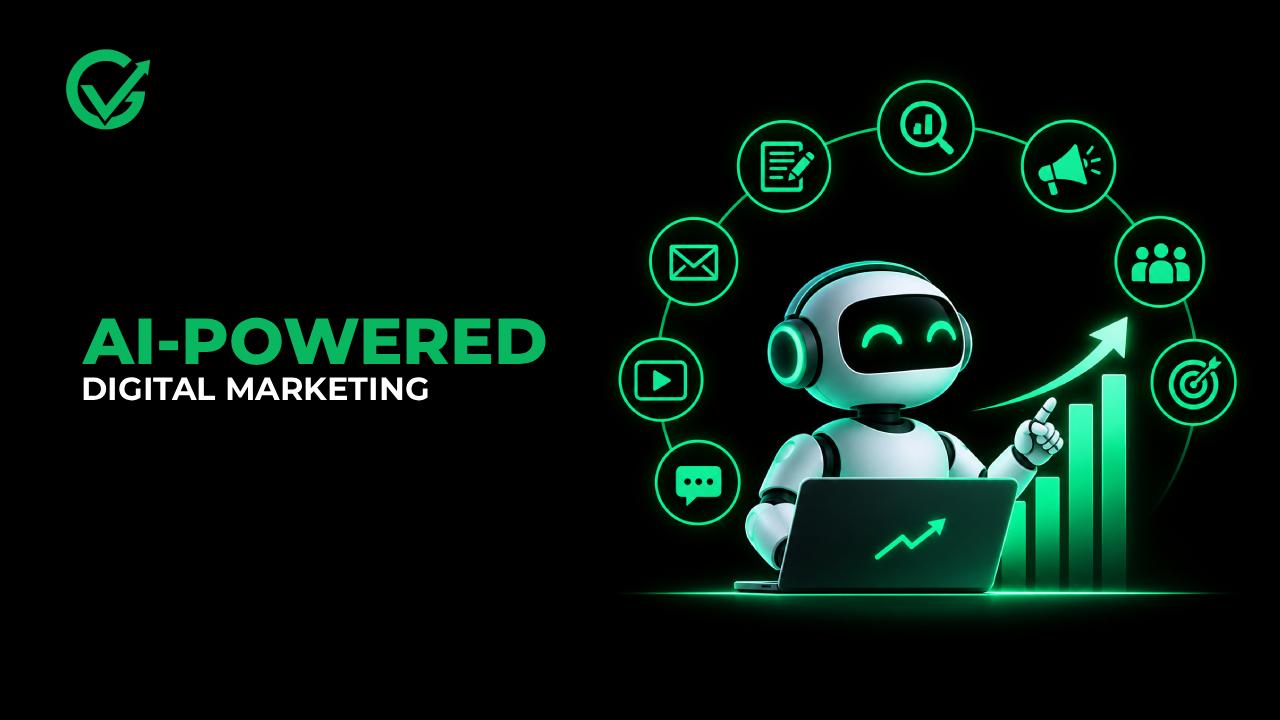
AI-Powered Digital Marketing: 10 Strategies for 2027
by Harini
November 19, 2026
Executive Summary
Discover 10 powerful AI-powered digital marketing strategies for 2027, including AI SEO, content marketing, predictive analytics, marketing automation, personalised campaigns, and intelligent advertising.
The digital marketing industry is evolving faster than ever, and artificial intelligence (AI) is becoming one of the biggest driving forces behind this transformation. From automated content creation and personalised customer experiences to predictive analytics and intelligent advertising, AI is changing how businesses attract, engage, and convert customers.
As we move towards 2027, traditional digital marketing techniques alone may not be enough to stay competitive. Businesses need smarter, data-driven approaches to understand customer behaviour, improve marketing performance, and deliver meaningful experiences across digital platforms.
AI-powered digital marketing combines artificial intelligence, machine learning, automation, and data analytics to make marketing activities more efficient and effective. Instead of depending entirely on manual research and decision-making, marketers can use AI technologies to identify opportunities, predict customer needs, optimise campaigns, and improve return on investment (ROI).
Whether you run a startup, small business, eCommerce store, or established company, understanding the latest AI digital marketing strategies can help you prepare for the future.
In this article, we explore 10 important AI-powered digital marketing strategies that businesses should consider implementing in 2027.
1. AI-Powered SEO and Generative Engine Optimisation (GEO)
Search engine optimisation (SEO) continues to be an essential part of digital marketing. However, search behaviour is changing with the growing popularity of AI-powered search experiences.
Search engines and AI platforms are increasingly helping users discover information through conversational answers, summaries, and recommendations. This makes it important for businesses to optimise their websites for both traditional search engines and generative AI platforms.
AI-powered SEO helps marketers identify relevant keywords, analyse competitors, discover content gaps, and improve website performance.
Businesses should focus on:
Generative Engine Optimisation (GEO) is also becoming an important consideration. It focuses on making brand information clear, useful, credible, and easy for AI-powered search systems to understand and reference.
For example, a digital marketing agency can publish detailed guides about SEO, social media marketing, PPC advertising, and content marketing to establish topical authority.
The key is not simply producing more content but creating content that genuinely answers users’ questions.
Why it matters in 2027
Businesses that combine traditional SEO with AI search optimisation can improve their opportunities for visibility across multiple digital discovery platforms.
2. AI-Driven Content Marketing and Content Creation
Content marketing remains one of the most effective ways to attract potential customers, build brand awareness, and establish industry authority.
However, consistently producing high-quality content across multiple platforms requires time, creativity, and resources.
Generative AI is transforming content marketing by helping businesses research topics, generate ideas, create initial drafts, and repurpose existing content.
AI-powered content marketing can support the creation of:
For example, a single blog article can be transformed into multiple LinkedIn posts, Instagram captions, email newsletters, and short-form video scripts using AI tools.
However, businesses should avoid publishing unedited AI-generated content. Content must be reviewed for accuracy, originality, relevance, brand voice, and usefulness.
Adding expert opinions, real-world examples, industry insights, and original research can make content more valuable.
AI should support human creativity rather than completely replace it.
Why it matters in 2027
Businesses can develop a consistent content marketing strategy, reduce repetitive work, and reach audiences through multiple digital channels.
3. Hyper-Personalisation Using Artificial Intelligence
Customers increasingly expect brands to understand their interests, preferences, and requirements.
Generic marketing messages often struggle to capture attention because different customers have different needs and buying behaviours.
AI-driven personalisation helps businesses deliver more relevant experiences by analysing customer interactions, browsing behaviour, purchase history, and engagement patterns.
For example, an eCommerce website can recommend products based on a customer’s previous purchases and browsing activity. Similarly, an online education company can send personalised course recommendations based on a visitor’s interests.
Businesses can use AI personalisation for:
AI can also help identify different customer segments and understand what type of messaging is most likely to engage each group.
However, businesses must use customer data responsibly and obtain appropriate consent when collecting and processing personal information.
Why it matters in 2027
Hyper-personalisation can help businesses improve customer engagement, increase conversions, and build stronger long-term customer relationships.
4. AI Marketing Automation and Intelligent Campaign Management
Marketing automation has already helped businesses reduce repetitive tasks, and AI is making these processes more intelligent.
Traditional automation generally follows predefined rules. AI-powered automation can analyse data, recognise patterns, and adjust certain marketing activities based on changing conditions.
This makes it possible for businesses to manage multiple marketing activities with greater efficiency.
AI marketing automation can be used for:
For example, when someone downloads an eBook from a business website, an automated marketing workflow can send a relevant follow-up email, provide additional resources, and notify the sales team when the lead demonstrates strong buying interest.
AI can help determine which messages, offers, and communication times are more relevant to different audience segments.
Businesses should establish clear approval processes for important customer communications and avoid allowing automation to send inaccurate or inappropriate messages.
Why it matters in 2027
Intelligent marketing automation can save time, improve campaign consistency, and allow marketing teams to focus more on strategy and creativity.
5. Predictive Analytics for Smarter Marketing Decisions
Making marketing decisions based only on past performance can limit business growth.
Predictive analytics uses historical data, machine learning, and statistical techniques to estimate future outcomes and identify potential opportunities.
In digital marketing, predictive analytics can help businesses understand customer behaviour and make more informed decisions.
For example, AI systems can analyse previous customer interactions to identify people who may be more likely to purchase a particular product or service.
Businesses can use predictive analytics to:
Consider an online retail business preparing for a festive sale. By analysing historical sales data, customer preferences, and browsing behaviour, AI can help estimate which product categories may receive higher demand.
Marketers can then plan inventory promotions, advertising budgets, and personalised offers more effectively.
Predictive analytics does not guarantee future results. Its accuracy depends on data quality, model performance, and changing market conditions.
Why it matters in 2027
Data-driven marketing decisions can reduce guesswork, improve resource allocation, and help businesses identify growth opportunities earlier.
6. AI-Powered Chatbots and Conversational Marketing
Customer expectations around online communication are changing. People want quick answers, convenient support, and personalised recommendations without waiting for business hours.
AI-powered chatbots and conversational marketing tools can help businesses respond to customer queries around the clock.
Unlike basic rule-based chatbots, modern AI assistants can understand natural language, recognise customer intent, and provide more relevant responses.
Businesses can use conversational AI for:
For example, a digital marketing agency can integrate an AI chatbot into its website to answer questions about SEO services, social media management, PPC advertising, and website development.
The chatbot can collect relevant enquiry details and direct qualified prospects to the sales team.
However, businesses should provide a clear option to connect with a human representative when a question is complex or requires personalised assistance.
AI chatbots should also be monitored to prevent inaccurate answers and misleading information.
Why it matters in 2027
Conversational AI can improve customer response times, support lead generation, and create more convenient digital experiences.
7. AI-Powered Social Media Marketing
Social media platforms continue to play an important role in brand awareness, audience engagement, and customer acquisition.
However, managing multiple social media channels requires consistent content creation, performance analysis, and audience interaction.
AI-powered social media marketing helps businesses simplify these activities and make better content decisions.
AI tools can analyse engagement patterns, identify trending topics, generate content ideas, and evaluate audience sentiment.
Businesses can use AI for:
For example, a business can analyse its previous Instagram posts to identify which content formats generate more engagement.
Based on these insights, marketers can plan more relevant content, such as educational carousels, short videos, customer testimonials, and industry updates.
AI can also help repurpose long-form content into shorter posts suitable for different social media platforms.
Nevertheless, brands should maintain their unique personality and engage authentically with their communities.
Why it matters in 2027
AI can help businesses manage social media more efficiently while improving content relevance and audience engagement.
8. AI-Driven Advertising and Smart Ad Optimisation
Paid advertising is an important digital marketing channel for businesses looking to generate traffic, leads, and sales.
However, running successful advertising campaigns requires continuous monitoring, audience targeting, creative testing, and budget optimisation.
AI-powered advertising tools can analyse campaign data and automate several optimisation activities.
Platforms such as Google Ads and Meta Ads already use machine learning to support bidding, targeting, delivery, and campaign optimisation.
Businesses can benefit from AI-driven advertising through:
For example, an online store can use automated bidding to optimise advertising campaigns towards conversions while monitoring the actual cost per acquisition.
AI can also help generate different advertising headlines and creative concepts for testing.
However, automation does not eliminate the need for strategic planning. Businesses should define campaign objectives, monitor conversion tracking, review spending, and evaluate profitability.
Why it matters in 2027
AI-driven advertising can help businesses optimise campaign performance, reduce manual management, and make more informed advertising decisions.
9. AI-Powered Video Marketing and Visual Content
Video marketing continues to be a powerful way to communicate information, demonstrate products, and build brand awareness.
Short-form videos, product demonstrations, educational videos, and customer testimonials are important content formats across digital platforms.
AI-powered video tools are making video production more accessible to businesses of different sizes.
These technologies can support:
For example, a business can convert an educational blog article into a short explainer video by developing a script, generating visuals, adding narration, and editing the final content using AI-assisted tools.
AI can also help businesses adapt video content for different audiences and languages.
However, video content should remain authentic, accurate, and aligned with the brand’s identity. Businesses should clearly disclose synthetic or AI-generated elements where required or where disclosure is important for audience trust.
Why it matters in 2027
AI-assisted video production can help brands create more visual content, communicate complex ideas, and reach audiences across multiple platforms.
10. AI-Powered Customer Experience and Voice Search Optimisation
Customer experience is becoming an increasingly important factor in digital marketing success.
Customers interact with businesses through websites, search engines, social media, messaging platforms, and mobile applications.
AI can help businesses connect these interactions and provide more consistent customer experiences.
AI-powered customer experience solutions can analyse customer feedback, identify common problems, and recommend improvements.
Voice search and conversational search are also important areas to consider as users increasingly interact with digital assistants and AI-powered platforms.
Businesses should optimise their websites for natural-language searches and conversational queries.
Important actions include:
For example, instead of targeting only a keyword such as "digital marketing agency", businesses can also create content that answers questions like "How can a digital marketing agency help a small business grow?"
This approach helps address specific user needs and supports broader search visibility.
Why it matters in 2027
Businesses that focus on intelligent customer experiences, conversational discovery, and accessible website content can build stronger relationships with their audiences.
Benefits of AI-Powered Digital Marketing for Businesses
Implementing AI-powered digital marketing strategies can offer several advantages.
1. Improved marketing efficiency
AI automates repetitive activities such as content drafting, reporting, scheduling, and customer follow-ups, allowing marketing teams to concentrate on higher-value tasks.
2. Better customer understanding
AI analyses customer interactions and behavioural patterns to provide useful insights into audience preferences and purchasing decisions.
3. More personalised experiences
Businesses can create relevant campaigns and recommendations for different customer segments.
4. Data-driven decision-making
Predictive analytics and performance analysis help marketers make decisions based on evidence rather than assumptions.
5. Improved campaign optimisation
AI can support advertising optimisation, content testing, and audience targeting to improve campaign effectiveness.
6. Scalable marketing operations
Businesses can manage more marketing activities without increasing manual workloads at the same rate.
Challenges of Using AI in Digital Marketing
Although AI offers significant opportunities, businesses should understand the challenges before implementing new technologies.
The best approach is to combine AI technology with human expertise, creativity, and strategic thinking.
How to Prepare Your Business for AI-Powered Digital Marketing in 2027
Businesses do not need to adopt every new AI technology immediately. Instead, they should develop a practical implementation plan.
Start by identifying marketing activities that consume significant time or resources.
Next, select AI tools that address specific business requirements, such as content development, SEO analysis, customer communication, or advertising optimisation.
Establish clear performance indicators to measure the results of each implementation.
Some useful metrics include:
Regularly review performance and improve your strategy based on actual results.
Most importantly, maintain a balance between AI-powered efficiency and human-led marketing creativity.
Conclusion
AI-powered digital marketing is becoming an important part of modern business growth. As technology continues to evolve, businesses that understand and adopt artificial intelligence strategically will have more opportunities to improve customer engagement, marketing efficiency, and campaign performance.
From AI-powered SEO and content marketing to predictive analytics, intelligent automation, conversational AI, and smart advertising, these 10 strategies highlight how artificial intelligence can transform digital marketing in 2027.
However, success will not come from using the maximum number of AI tools. It will come from selecting the right technologies, understanding customer needs, maintaining data quality, and delivering genuine value.
Businesses should view AI as a powerful marketing assistant rather than a complete replacement for human expertise.
At Growth Voice, we believe the future of digital marketing belongs to businesses that combine technology, creativity, and smart strategies to achieve sustainable growth. Start exploring AI-powered digital marketing today and prepare your business for the opportunities of 2027.
Ready to Build Your Winning Strategy?
Connect with our dedicated marketing strategists for a comprehensive audit and custom execution blueprint.
Speak to a Specialist